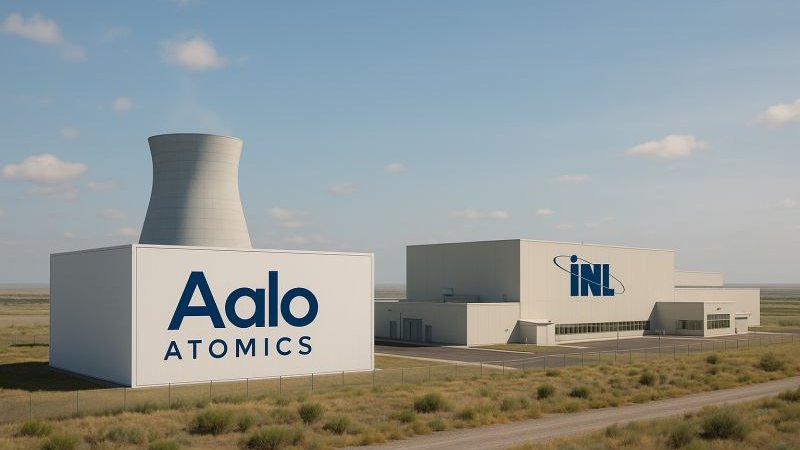
Aalo Atomics working with INL
Credit: Aalo Atomics LinkedIn image
In an interview on Newstalk 107.9, Richard Williams, the Director of Engineering at Aalo, discussed a significant technical milestone for the nuclear energy startup. Williams confirmed that the company’s fourth reactor has officially gone “critical,” a term signifying that the reactor has achieved a sustained fission reaction capable of maintaining steady heat without external input.
Speaking with hosts Neal Larson and Julie Mason, Williams explained that this achievement is a major step toward the company’s goal of providing modular nuclear power. Unlike traditional large-scale reactors, Aalo’s design focuses on small, factory-built units that can be transported by truck and assembled on-site. Each reactor is designed to produce 10 megawatts of power, with the ability to combine units into 50-megawatt “pods” to serve specific industrial needs.
The primary target market for these reactors is the data center industry. As these facilities continue to grow in size and power consumption, Aalo aims to provide a dedicated energy source that avoids straining the existing electrical grid. Williams noted that the modular nature of the technology allows the power supply to scale alongside the facility’s growth, much like the “Lego block” expansion of the data centers themselves.
Currently, Aalo holds a memorandum of understanding with Idaho Falls Power. While not yet a formal contract, the agreement signifies a mutual interest in integrating nuclear power into the local grid if production costs become competitive. Williams acknowledged that while nuclear cannot currently compete with the low cost of hydroelectric power in the Pacific Northwest, a target price of under 10 cents per kilowatt-hour could make the technology viable for “peaking” purposes and regional power distribution.
Addressing safety and environmental concerns, Williams described the technology as a “Gen 4” reactor that is passively safe. The design is intended to self-shut and cool down even without human intervention. The company aims for commercial deployment by 2030, with the first powered reactor expected at their site as early as next year. This progress aligns with recent federal interests in accelerating domestic nuclear hardware production to ensure energy independence.