
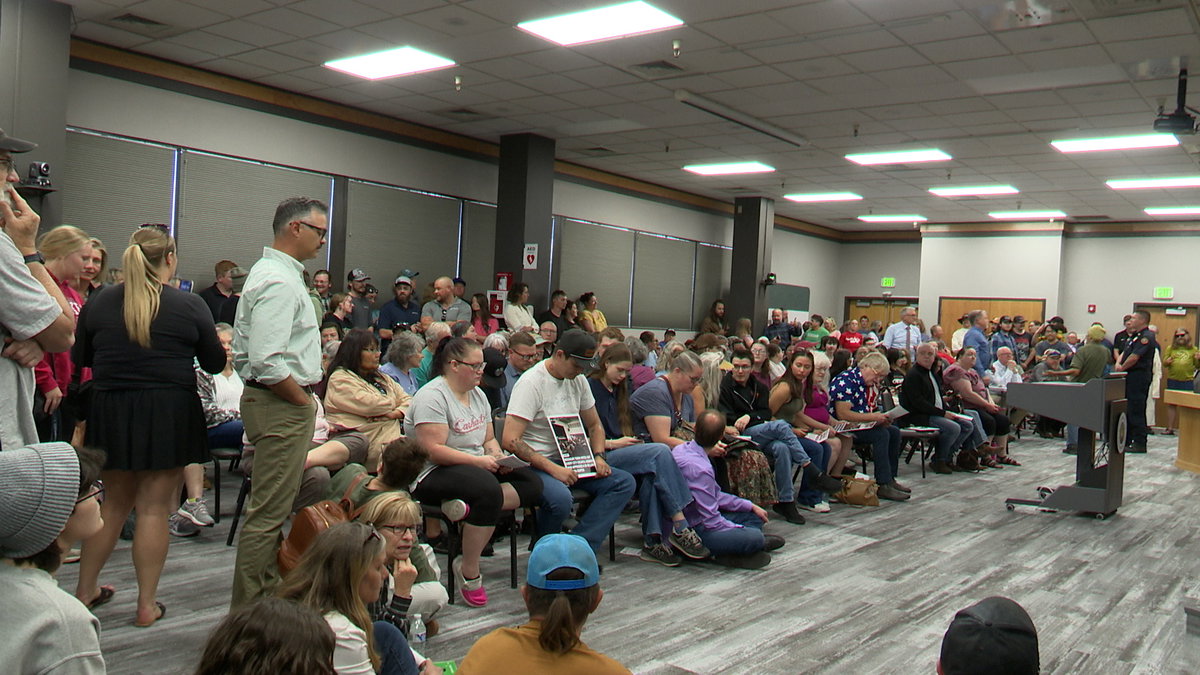

POCATELLO, Idaho (KIFI) – Tonight’s public hearing at City Hall in Pocatello turned tense when attendees interrupted, booed speakers, and were escorted out by Pocatello policemen. The hearing was held for community members to voice their opinions on the proposed AI Data Center, which would be built on the former Hoku polysilicon plant site.
Hundreds showed up to pack the City Hall building. Many were forced to stand outside or in the lobby to watch a livestream of the hearing. The hearing examiner first invited a representative from the applying company to explain the project to the community.
Lex Developments, an Arizona-based company, purchased the property and has now applied for a conditional use permit. They seek to greenlight the project to bring this massive technology to Pocatello as well as “hundreds of jobs.”
Gus Shultz spoke about the proposed data center at 1800 River Park Way. When asked specific questions by the examiner, Shultz was unable to provide concrete details about the demands for power and the extensive nature of the campus.
“When you look at the site, it’s very unique,” Shultz said. “We don’t know the size yet until we know the power, once we get more research. But right now we just design, and I think there’s seven different buildings on the site.”
The audience interrupted with comments and disapproval of Shultz’s lack of detail and confidence in the project. One attendee commented he needed to come here to “make a sale” and “didn’t do that.”
Shultz said they are currently working with Idaho Power to determine the power usage the plant would require. Another concern with the data center is the water usage pulling from Pocatello resources.
“People need to know that we are not going to use much more than four or five households worth of water,” Shultz said, leading to an uproar from the crowd at City Hall. An outspoken citizen said that was a “severe underestimation” of the water usage by an AI data center.
Next to the podium was Jennifer Flynn, the assistant planner for the City of Pocatello Planning Department.
“The city wanted to bring this proposal to the public’s awareness to give interested parties the opportunity to provide public comment,” Flynn said. “The applicant is requesting permission to develop land for a data center on the subject property, encompassing approximately 59 acres in the industrial zone.”
Flynn continued to say that if the development becomes an approved use for the land, it would still have to undergo required processes and permitting approvals before construction could begin. Tonight’s hearing and the conditional use permit application are the first steps in the process of bringing an AI Data Center to Pocatello.
She also read from a statement given by Idaho Power, which in part said, “At this stage, our development and evaluation of the Lex Development Data Center project is limited to preliminary engineering analysis. More detailed studies will be necessary to fully define the scope of required infrastructure and generation resources.”
Based on these preliminary studies, Idaho Power said it believed it could provide the requested power for the plant without impacting services to existing customers. Lex Development itself would be responsible for funding upgrades to support any generation resources on Idaho Power’s systems.
Flynn said following tonight’s hearing, if the permit is allowed, permitting and analysis are the next steps for Lex Development. This includes financial standards that the company has to meet for the project to move forward.
Community members were able to submit a written testimony or speak at the podium at the hearing. The hearing examiner opened the floor to people in favor of the project, followed by those against.
“I believe the data center project is potentially a historic and transformative opportunity for our community,” said John Edwards, a Pocatello resident in favor of the project. “The project will see hundreds of well-paying construction jobs, and once operational, the project will generate over 150 permanent local jobs.”
The few people who spoke in favor of the project mentioned its economic benefits for schools, buildings, recreation programs, and local parks without raising taxes on existing residents. Edwards also mentioned the opportunity for students at Idaho State University to stay in town and find jobs in technology, computer science, and engineering at the Lex Development Data Center.
This point comes just as ISU announced its new Artificial Intelligence Sciences major, which supporters argue an AI data center in Pocatello could help enhance.
“The cooling system proposed is a closed-loop system, which can easily be integrated into such infrastructure,” said Ralph, an ISU 2026 graduate in software engineering. “I think it would be great for the city to investigate building out infrastructure that can harness data center heat.”
Some in the crowd spoke up about climate change, saying Idaho no longer needs heat with the warmer winters. “Everyone is emotionally charged here,” stated Ralph.
Meanwhile, people opposed to the project argued the closed loop isn’t really closed at all, and would cause more harm than good.
“The best closed system is only about 70% efficient, and it’s not uncommon for a closed system to be flushed of 25% of its water volume each and every month,” said Jim DiSanza, Pocatello resident and Department Chair at ISU. “When you used to flush your radiator at home, and then you put it in the garden, what came out was not great. It was brown to black. So this is not a truly closed system.”
Despite efforts from the hearing examiner to keep comments to land usage issues, the conversations consistently argued about the nature of data centers and their implications.
“What will be done with the waste heat?” asked Linda Engle, a member of the Portneuf Resource Council. “Will it be vented to the atmosphere? It appears this may create a heat island. How will that affect the river?”
The list of concerning questions could go on. Another major concern was noise pollution, to which one resident put her phone to the microphone and played a buzzing sound, stating, “do we really want to hear this every day coming from a data center?”
Lee Ireman was more concerned with the taxes in relation to the project, stating, “Right at the beginning, planning would be put there by the taxpayer. So what we need to have them do is create a large loaded tariff that they guarantee not only do they pay for all the infrastructure build out, but they also pay for any rate difference that would be passed on to the taxpayer.”
Another resident, Nancy Legge, took her turn at the podium to discuss the public services side of the project. “There’s a lot of confusion in the application between 100 megawatts or 200 megawatts, but there is no confusion on the fact that Idaho Power says this is more than what Pocatello consumes in a single year.”
Others echoed the sentiment that the proposal was vague and lacked details that residents need to understand to support the project. Many Pocatello community members are concerned about the well-being of residents and the environment in relation to this massive project so close by.
Tonight’s hearing brought out people of all ages, including several speakers against the proposal from Highland and Pocatello High Schools.
“We can’t waste our land and our resources on a data center. We need to put it towards infrastructure that helps,” said one sophomore student from Pocatello. “I really don’t want to come back to this town in six years and see that, I want to see that it’s flourishing because we used this land to put something amazing there.”
Teachers from across the area also showed up at the public hearing. “There is potential of a 267% increase in the cost of electricity,” cited Maximo Orr, a teacher at Pocatello High School. “And to me, that is not worth any potential material gains that we could get from this data center.” He added that he and others struggle to trust a company like Lex Developments, not because they’re out of state, but because they did not come forward with clear information. Others called Lex Developments a “distant, billionaire company.”
At 8 p.m., the hearing had not concluded, and there were still over 20 residents waiting in line to speak at the podium and share their testimony. It began at 5:30 p.m., and each speaker was limited to three minutes.
This is a developing story, and Local News 8 will continue to follow the details and update you as more information becomes available.