
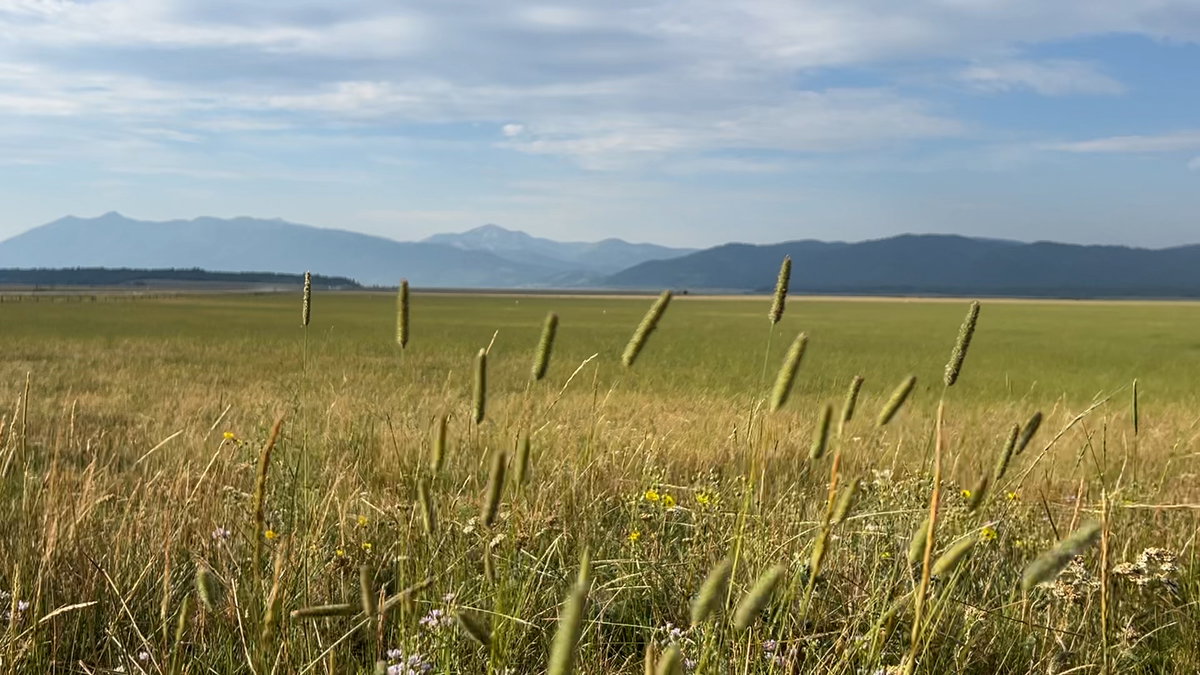

ISLAND PARK, Idaho (KIFI) – Residents and officials are sounding off after Fremont County Commissioners’ decision to approve the Caldera Flats development on Henry’s Lake Flats in Island Park last Monday.
“Nobody who’s seen the flats – the Henry’s Lake Flats – will be surprised that a lot of people are concerned about what happens there. It’s a beautiful place,” said Tom Cluff, Fremont County’s Planning and Building Administrator. “It’s one of the scenic gems of Fremont County. There’s a subdivision proposed there and a lot of concern about what effect that subdivision will have – how it will impact wildlife, water quality, scenic views, those sorts of things.”
The 160 acres north of the Island Park Cemetery could soon be turned into 32 single family homes, on minimum five-acre lots.
The project is owned by Doug and Kevin Button, of DK Land LLC.
Hundreds of Island Park residents protested development on the flats, with 500 showing up at a previous Planning and Zoning meeting – most in opposition.
“The idea that they had is not bad. It’s just where they put it was a problem,” said Loy Schroeder, former Fremont County Planning and Zoning Chairwoman. “The biggest concern initially was wetlands. It is a wetland area, and when you put homes on wetlands, they tend to be destroyed. You can’t go back on them if they fail. It has antelope that have their babies there. It has elk. It has long-billed curlew that nest on it.”
She’s also concerned about the impact on the Henry’s Fork world-class fishery.
“The Henry’s Fork that runs through the adjacent property – within less than a quarter of a mile from the Button property – stands to be contaminated,” she said.
The Fremont County Planning and Zoning Commission initially denied the application for the subdivision in May.
But in a 2 to 1 vote, Fremont County Commissioners Rick Hill and Mark Chandler overrode that decision. Commission Chairman Blair Dance disagreed, stating the application should be sent back to Planning and Zoning for further consideration.
“The development code says you can have a subdivision in that zone. They felt like if we say you can have a subdivision and you follow our rules, your subdivision should be approved,” Cluff said. “There’s a property rights element that they felt was important, that whatever other concerns we have don’t outweigh that.”
The County Commissioners placed requirements on the developer – including that each home provide wildlife-friendly fencing and connect to Island’s Park sewer system rather than installing individual septic systems.
“A subdivision has to set aside a certain amount of property as open space. In this case, the requirement was 65 percent. The developer’s setting aside almost 70 percent,” Cluff said. “The subdivision has to have a plan to mitigate wildlife impacts. … They have to have a master plan. They have to address stormwater design.”
Fremont County’s Planning and Building staff has also recommended that the HOA require native vegetation in open spaces and restrict planting trees to minimize impacts on wildlife and the environment.
But for Schroeder and others, the changes don’t go far enough.
“The biggest problem right now is that the development code has not been updated since 2008,” Schroeder said. “… Adding into the development code for protection of water areas, hydrology areas – the hydrology that feeds the Henry’s Fork, [and] feeds the Buffalo. All of those things need to be added into our development code and our comprehensive plan. … It can be done in a year.”
Schroeder left the Planning and Zoning Commission in December.
“My biggest question, which I was unable to ask at the last meeting because it was not a public hearing, was what changed? I just want to know what changed. Why did they pass it the first time and deny it during the appeal?”
The project still requires final approval from the County Commissioners before construction can begin, which could be within the next two years.
Some residents in Island Park have threatened to file a lawsuit over the development.