
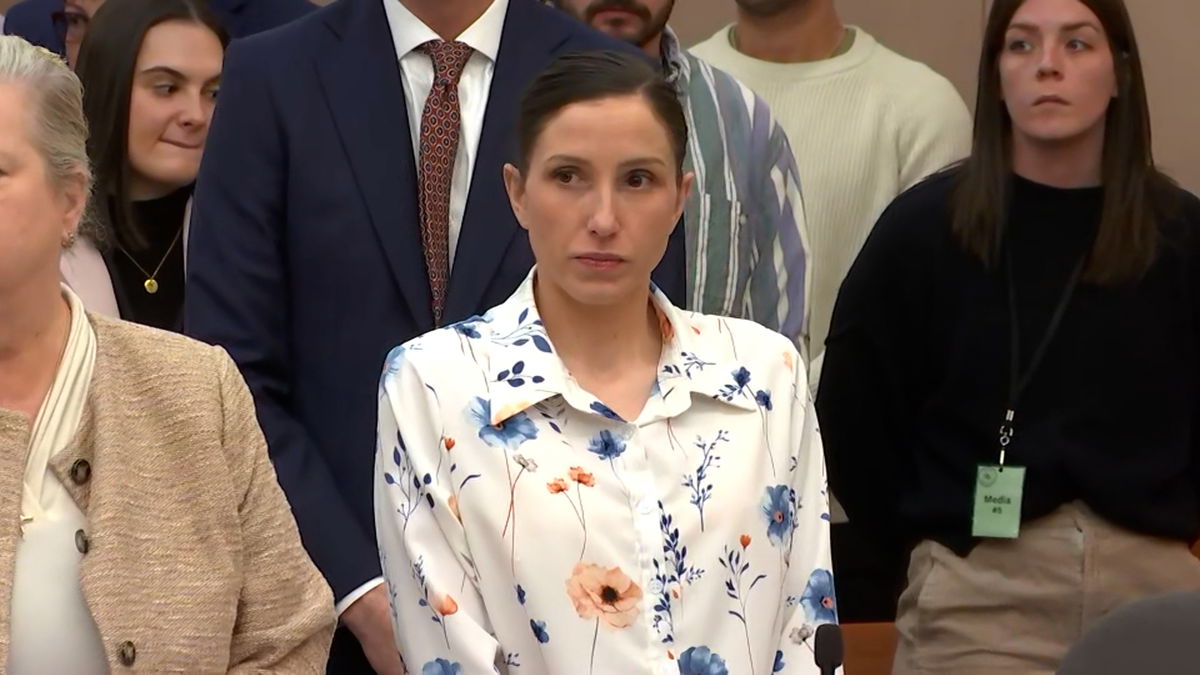
Utah jury finds Kouri Richins guilty of murdering her husband">Utah jury finds Kouri Richins guilty of murdering her husband

Utah jury finds Kouri Richins guilty of murdering her husband">

UPDATE 6:40 p.m. PARK CITY, Utah (KIFI) — A jury found Kouri Richins guilty of murdering her husband on Monday evening. She was accused of poisoning her husband, Eric, with fentanyl in 2022.

The jury found the defendant guilty on all 5 counts, which included aggravated murder, attempted criminal homicide, two counts of fraudulent insurance claims, and forgery.

The verdict came in just after 6:30 p.m. after deliberation on Monday afternoon.

Richins is scheduled to be sentenced on May 13, 9:30 a.m.

PREVIOUS STORY:

PARK CITY, Utah (KIFI) — Closing arguments began Monday in the high-profile murder trial of Kouri Richins, the Utah mother accused of fatally poisoning her husband, Eric Richins, then writing a children’s book about coping with grief.

The case now moves to the jury for final deliberations.

The Prosecution – ‘The sound of a black-widow.’

In the state’s closing arguments, Summit County prosecutor Brad Bloodworth painted a picture of a woman driven by a desperate need for status and privilege. According to the state, Kouri’s motive was a mix of failing finances, control over her husband’s $4 million estate, and her affair with Robert Josh Grossman.

Monday, Bloodworth opened by detailing Kouri’s background, alleging she sought to distance herself from a troubled childhood by projecting a life of privilege and success. Bloodworth says Kouri achieved this goal when she met and married Eric Richens, a successful business owner. However, prosecutors argue that after three children and several years of marriage, Kouri wanted out but refused to leave the wealth behind.

“All the while, Kouri Richins was more interested in spending time with Josh Grossman than Eric,” said Bloodworth. “She dreams of living in the Midway mansion with Josh, running it as an event center, farming it, and raising kids. But she did not have the money to leave Eric.”

The state alleges that Kouri siphoned $250,000 from Eric’s accounts to fund her own failed business ventures, hoping to earn enough money to leave him. Witnesses testified that she asked for illicit drugs before ultimately getting hold of the fentanyl used in the murder. Furthermore, prosecutors revealed Kouri had already booked a future vacation with Grossman for a date she knew Eric would not live to see.

The state argues that Kouri spiked Eric’s Moscow Mule with five times the lethal limit of fentanyl. To close his argument, Bloodworth replayed the first minute of the 911 call Kouri made the morning Eric was found dead. Bloodworth stated that the recording was not the sound of a wife becoming a widow, but instead “the sound of a wife becoming a black widow.”

The Defense – “Kouri Richins’ world collapsed.”

Defense attorney Wendy Lewis countered by painting Kouri as a caring mother and attempting to discredit the prosecution’s star witness, the Richens’ former housekeeper Carmen Lauper.

Lewis opened her arguments by revisiting the night of March 3rd, 2022, when the couple was celebrating the closing of the Midway Mansion. She described a mother tending to a crying child before returning to her bedroom to find her world had collapsed.

“Something feels wrong,” said Lewis. “[Kouri] turns on the light, and when she looks at her husband, really looks at him, she realizes something is terribly wrong. In that moment, Kouri Richins’ world collapsed.”

She also attacked the credibility of Carmen Lauper, who claimed to have sold Kouri the drugs, saying that Lauper changed her story numerous times. Lauper was already in a drug court program as an alternative to incarceration on other charges when authorities arrested her in connection with the Richins case, according to the Associated Press.

“She’s not a truthful person,” argued Lewis, framing Lauper’s testimony as a “get out of jail free” in the face of a long prison sentence.

While acknowledging Kouri’s affair and how she’d deleted certain text messages, Lewis speculated her client may have deleted texts due to an affair or drug purchases.

The closing arguments capped three weeks of testimony where the defense rested its case without calling any witnesses. If convicted of the charge of aggravated murder alone, Kouri Richins faces a potential sentence of life in prison.

“We are sorry”; Teton County settles lawsuit over wrongly charged $25,000 housing fee">“We are sorry”; Teton County settles lawsuit over wrongly charged $25,000 housing fee

“We are sorry”; Teton County settles lawsuit over wrongly charged $25,000 housing fee">

JACKSON, Wyoming (KIFI) — Teton County has issued a rare apology and a nearly $30,000 refund to a Jackson couple after admitting it “incorrectly calculated” an affordable housing fee that sparked a years-long legal battle. What the county called a staff mistake, business owners Trey and Shelby Scharp called a “hostage” situation over their building permit.

“Teton County made a mistake. We required you to pay an affordable housing mitigation fee that you did not need to pay,” county leadership said in a statement Monday. “We are sorry. We regret every minute of distress this litigation caused you,” the statement continued.

The case began in 2021 when local business owners Trey and Shelby Scharp bought a five-acre property with a 1,000-square-foot cabin on it. They planned to build a new family home on the property while living in the cabin, then turn the cabin into a rental after their new home was ready.

Teton County officials told the Scharps their cabin was too big to be considered an auxiliary dwelling unit. Then, when they applied for a building permit for the new house in 2022, the county said they were required to pay $25,000 for an “affordable workforce housing fee.”

The idea for the fee is that building in the Jackson area will create construction jobs and service jobs; however, because it is one of the most expensive housing markets in the country, these workers will not be able to afford housing in the same area. The resulting fee to the builder is meant to fund subsidized housing for the area workforce.

The Scharps sued Teton County in May 2025. “Teton County cannot hold building permits hostage until property owners pay excessive fees unrelated to their projects,” said their attorneys at the Pacific Legal Foundation, “Such requirements unfairly burden families like the Scharps who simply want to build a home and help solve local housing problems,” referencing the Sharp’s plan to rent out the smaller cabin once their new family home was finished.

“The residential site included a historic structure,” Teton County said, in reference to the existing cabin, “and credit for the historic structure was applied incorrectly. When this credit was properly applied, the floor area for the overall project dropped below 2,500 square feet, negating the affordable housing mitigation fee.”

The Pacific Legal Foundation says under the settlement agreement, “the County will refund the Scharps the $24,325 in ‘affordable workforce housing’ fees, as well as 7% interest since the fee was imposed, for a total of $29,909.00.”

The mitigation fees have been controversial and challenged before. Wyoming House Bill 141 would have prohibited cities and counties from imposing those fees; however, it failed in Wyoming’s 2026 Legislative session.

Serving up school lunch success: Potandon Produce pays it forward at Dora Erickson Elementary">Serving up school lunch success: Potandon Produce pays it forward at Dora Erickson Elementary

Serving up school lunch success: Potandon Produce pays it forward at Dora Erickson Elementary">

IDAHO FALLS, Idaho (KIFI) – As hungry kids struggle to for school lunch throughout East Idaho, Potandon Produce is challenging other businesses to help pay off outstanding school lunch balances at local elementary schools.

“Over Christmas, my sister and I were talking. She’s a former educator, and she had suggested [helping] school lunch programs,” said T.J. Christenson, a Potandon Gives ambassador. “They have negative balances typically, so I reached out to my nephew’s school, Dora Erickson, to see what their negative lunch balance was, and it was a hefty total.”

Potandon launched a community giving initiative last June, seeking to give back and strengthen the community. 

“We have an entire list – up and down the valley – of the negative lunch balances,” Christenson said. “So we started with Dora Erickson and donated to them.”

The Potandon Gives program donated $2,500 to cover all of the negative lunch balances (with extra to assist through the end of the year) at the school on Thursday.

Those unpaid school lunches sure add up fast.

In District 91 alone, elementary students and their families owe about $25,000 for school lunches, a number that continues to grow, she said.

“We wanted to be able to ensure that the kids are getting fed and that they have food security,” Christenson said. 

She hopes other people and corporations will help step up to the plate.

“We’d love for the community to go out and support their local schools – whether it’s an individual or whether it’s a business, go out, pay off the school lunch balance,” she said. “If it’s the school in your neighborhood, your kids go there, your grandkids go there – go and support the kids.”

In the past nine months, Potandon Gives has donated a total of $74,100 to a variety of youth sports organizations, D.A.R.E., Rocket Club, Business Professionals of America, an eSports team, St. Vincent de Paul, Shepherd’s Inn and Elks Lodge. 

Last week, it provided $12,000 total in checks to Dora Erickson Elementary, the Community Food Basket, American Falls High School’s band and first aid buckets at Fairview Elementary.

With so many non-profit organizations in the region, Potandon Gives has not duplicated a donation.

Potandon is the exclusive distributor of Green Giant Fresh potatoes and onion.

If you would like to assist covering school lunch balances in District 91, you can visit this website on the District’s official page. (You can type in the name of the school you are helping under “Memo.”)

Potandon Produce invites you to give back by helping cover unpaid student lunch balances at your local school.

INTERVIEW: Sen. Doug Ricks on Budget Standoff, Legislation">INTERVIEW: Sen. Doug Ricks on Budget Standoff, Legislation

INTERVIEW: Sen. Doug Ricks on Budget Standoff, Legislation">

In a recent interview on Newstalk 107.9 with hosts Neal Larson and Julie Mason, State Senator Doug Ricks provided insight into the escalating tensions and procedural hurdles defining the current Idaho legislative session. Ricks described a Capitol atmosphere marked by exhaustion and impatience as lawmakers struggle to resolve significant budgetary disagreements and policy disputes before adjournment.

A primary point of contention involves a major budget standoff within the Idaho Senate. During the broadcast, Larson and Mason noted that the failure of a recent budget vote stemmed from a structural divide rather than any single floor speech or individual effort. According to the analysis, the legislation faced opposition from two distinct factions: Democrats, who argued the budget provided insufficient funding for state programs, and conservative Republicans, who contended that the spending levels remained too high or were not properly targeted for cuts.

This impasse has created significant challenges for the Joint Finance-Appropriations Committee (JFAC). The committee recently canceled a scheduled meeting because a clear path toward a compromise had not been established. Lawmakers are currently tasked with identifying specific adjustments that could move enough “no” votes to “yes” without losing the support of those who already favor the current spending plans.

The interview also touched on broader concerns regarding legislative transparency, specifically the practice of holding bills in committee “drawers” to prevent them from reaching the floor for a vote. Larson and Mason argued that such tactics frustrate both constituents and legislators, suggesting that lobbying pressure may play a role in shelving certain proposals. One specific dispute highlighted involves the payroll deduction of teachers’ union dues. The discussion suggested that legislative leaders should prioritize implementing state law over union negotiations, proposing that school districts should only deduct dues if they choose to do so, rather than being mandated by existing frameworks.

Senator Ricks was characterized by the hosts as a consistent and plainspoken presence in a legislative environment that they described as increasingly performative. As the session nears its conclusion, the ability of leadership to overcome these internal divisions and move forward with essential funding bills remains the primary focus of the statehouse.

scroll to top