
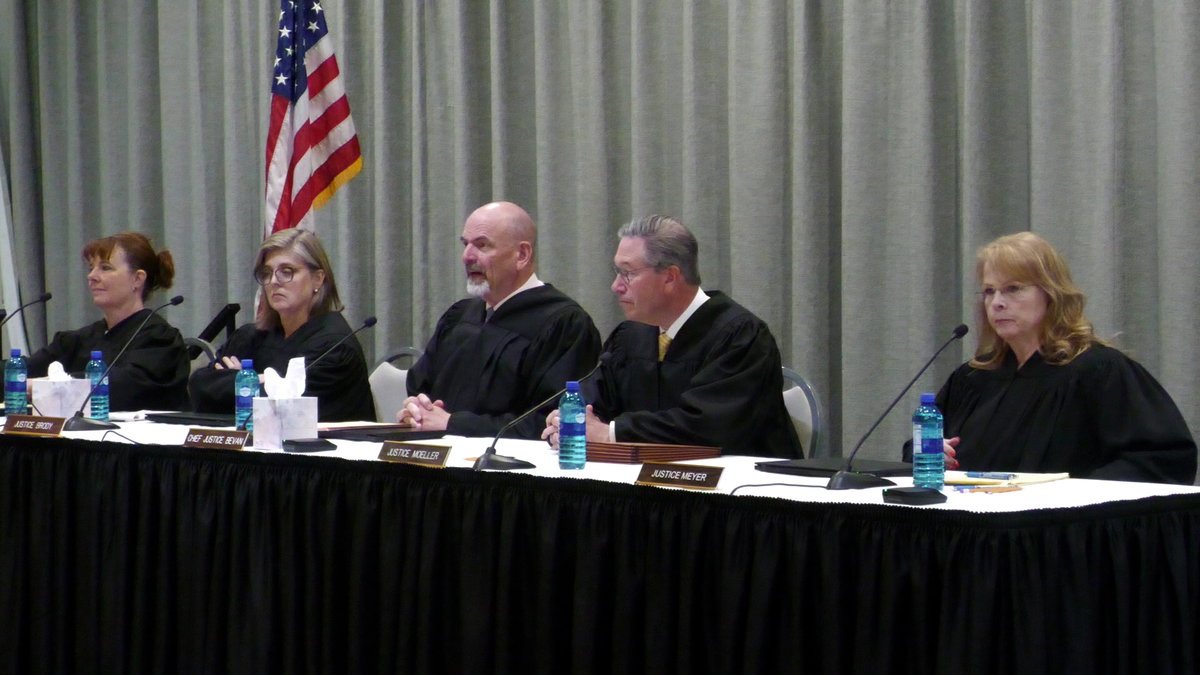

REXBURG, Idaho (KIFI) – Five justices of the Idaho Supreme Court visited Brigham Young University-Idaho Wednesday to hear oral arguments in three cases from eastern Idaho.
The justices heard from lawyers in an appeal of a domestic battery conviction, a probate case and a dispute from Bonneville County over court records fees.
In State of Idaho v. Tony Crombie, Crombie appealed his conviction for domestic battery.
“The unwaived constitutional right that was violated here was Mr. Crombie’s right to fair notice of the charges against him. He had no idea that he was on trial for felony domestic battery, and he did not tailor his defense to the elements in that charge,” argued his lawyer Stacey Donahoe. “… We think that the only proper remedy in this case is to vacate his conviction.”
Idaho Deputy Attorney General Neil Paterson disagreed with that characterization.
“Crombie has not shown a violation of an unwaived constitutional right because the variance between the jury instruction and the pleading document was not fatal. Likewise, the record does not show that there was a clear error because there was not a failure to object, but rather a strategic decision to object on a basis that best fit his defense that he did not touch the victim, ” he said.
The second case, Travis Bowen v. Dana Penrod consisted of a dispute between a brother, Travis Bowen, and his sister, Dana Penrod.
After their sister, Deborah Bowen, and their father passed away, Travis was appointed as the personal representative for Deborah’s estate, while Dana oversaw her father’s estate.
Travis alleges that some of Deborah’s property was sold by Penrod at a July 2020 auction along with their father’s belongings, and requested that the value of Deborah’s property be sent to her estate.
His lawyer Stephen Adams argued that “he filed the petition to try and find out where the property went to and to collect it.”
Penrod was represented by lawyer Nathaniel Wadsworth, who stated a “three year statute of limitation applies, and the court properly dismissed the complaint, and the district court properly affirmed that dismissal.”
The third case, Bryan Smith v. Penny Manning (in her official capacity as Bonneville County Clerk), Smith challenged the Bonneville County Clerk’s Office after he was charged a $352 fee for public records.
The fee was assessed after Smith requested judgments from 169 cases on an electronic thumb drive.
The District Court ruled that “the Clerk had absolute quasi-judicial immunity from suit and dismissed both claims without addressing whether Smith had been overcharged,” the docket states.
“It cannot be the law that the government can take your property, overcharge you, and then when you ask for your money back, they say we’re immune,” Smith said.
Bonneville County Prosecuting Attorney Randy Neal disagreed, stating, “Where did the overcharge occur? If that requires an interpretation of the law, then I have to say my client is probably either 1) not the person who interpreted the law, so we go to the administrative district judge, or 2) you’re asking her to do something which was not ministerial or administrative.”
In each case, the justices peppered lawyers with piercing questions.
The Idaho Supreme Court took Wednesday’s cases under advisement and will release its decisions at a later time.
Following the hearings, the judges discussed their roles and decision-making process in the court, while answering questions from students and guests at the university.
“We are elected officials. We need to act like it in the sense that we understand we are responsive, that we’re transparent as we can be to the public, and that we strive to be out and about,” said Chief Justice G. Richard Bevan.
Another question dove into whether or not the judiciary has been politicized.
“It isn’t about politics. It’s about deciding the cases,” said Justice Cynthia Meyer. ”It’s about following the rule of law, looking at the facts that are developed throughout the case, and making the right decision regardless of whatever political winds may be blowing at the time.”
Justice Gregory Moeller, former District Judge for the Seventh Judicial District, affirmed that a judge’s duty is to uphold the rule of law.
“We have to understand that the decisions we make are much bigger than our own personal views,” Moeller said. “We often make decisions that we personally don’t like. For us, the only vindication is that we follow the law. We want the law to win. We want the rule of law to govern, and if that happens, it doesn’t really matter who won or lost.”