
IDAHO FALLS, Idaho (KIFI) — NASA Administrator Jared Isaacman declared Friday that the U.S. will win the second and third space race back to the moon, Mars and beyond.
“The outer solar system contains some of the most compelling destinations of exploration. The oceans beneath the ice of Enceladus, the complex environment of Uranus and its moons, the distant worlds and unexplored regions that may hold the answers to some of humanity’s oldest questions – like are we alone?” Isaacson shared. “These are not destinations we should visit once every generation, because planetary alignment is rare and transit times are so long and the missions are just extremely expensive. We should be building the capability to explore them routinely.”
The leader of NASA visited Idaho for the first time ever today to highlight INL’s role and growing partnership with the space agency.
“That requires fission-powered spacecraft – capable of traveling farther, operating longer and supporting more power-intensive instruments to help us uncover the secrets of the universe,” he said.
His speech was part of the “NASA Inspiration Tour: Going Nuclear with Idaho National Laboratory,” where Isaacman met with leaders of the Radiant, Antares, and Deployable Energy microreactors.
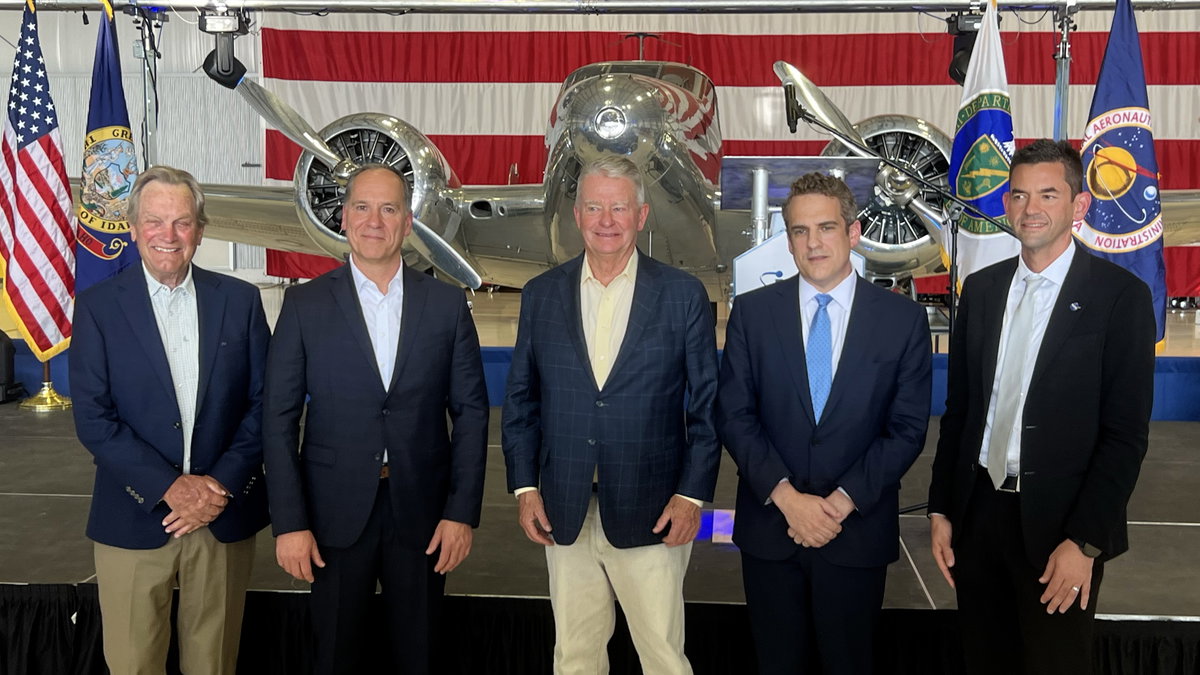
The visit concluded with a historic press conference at the Aero Mark general aviation hangar at the Idaho Falls Regional Airport with Isaacman, Gov. Brad Little, Rep. Mike Simpson and U.S. Deputy Secretary of Energy James Danly.
Local News 8’s livestream of the full event is included below.
The seeds of future space travel started here in the Idaho desert.
“For more than 70 years, Idaho has been the center of American innovation,” Gov. Little said. “Right here in INL, our nation proved what was possible by generating the first usable electricity from nuclear power.”
Rep. Simpson, who advocates for INL funding on the House Appropriations Committee, said the laboratory’s collaboration with NASA will continue to expand.
“The INL and NASA has long had a good partnership, working together on space batteries and other things. It’s going to become greater in the future as we look at reactors for the moon and other places. It’s going to be amazing what happens in here.”
The leaders embrace a future where creativity is encouraged, the impossible is made possible, and space travel expands deep into the galaxy.
“There was a time in which we had innovation that ran so quickly that in a single human lifespan, we went from a powered kite at Kitty Hawk to Tranquility Base in the course of one human lifespan. Just think about that,” said U.S. Deputy Secretary of Energy James Danly. “We are recapturing that spirit of innovation and that rate of innovation with the return to the moon, with the Artemis mission and the development of the reactors that are going to have to power yet another generation of NASA’s missions.”
Isaacman’s vision to reach the furthest expanses of space is powered by the radioisotope thermoelectric generators and advanced nuclear reactor development occurring at INL.
“The stars belong to everyone. Now, NASA, alongside our our partners in the Department of Energy and alongside American industry as well, must once again recalibrate, shift our resources away from what others are already capable of doing, and do what no other company, agency, or frankly, what other nation is capable of accomplishing.”
Isaacman said today’s kids and young people will be the new astronauts, engineers and scientists who will dare to dream, dare to achieve, and dare to join those propelling humankind deep into outer space.
“We must unleash more of the energy potential within matter and use it to overcome the tyranny of distance across our solar system, especially as we venture farther away from our star,” he said.