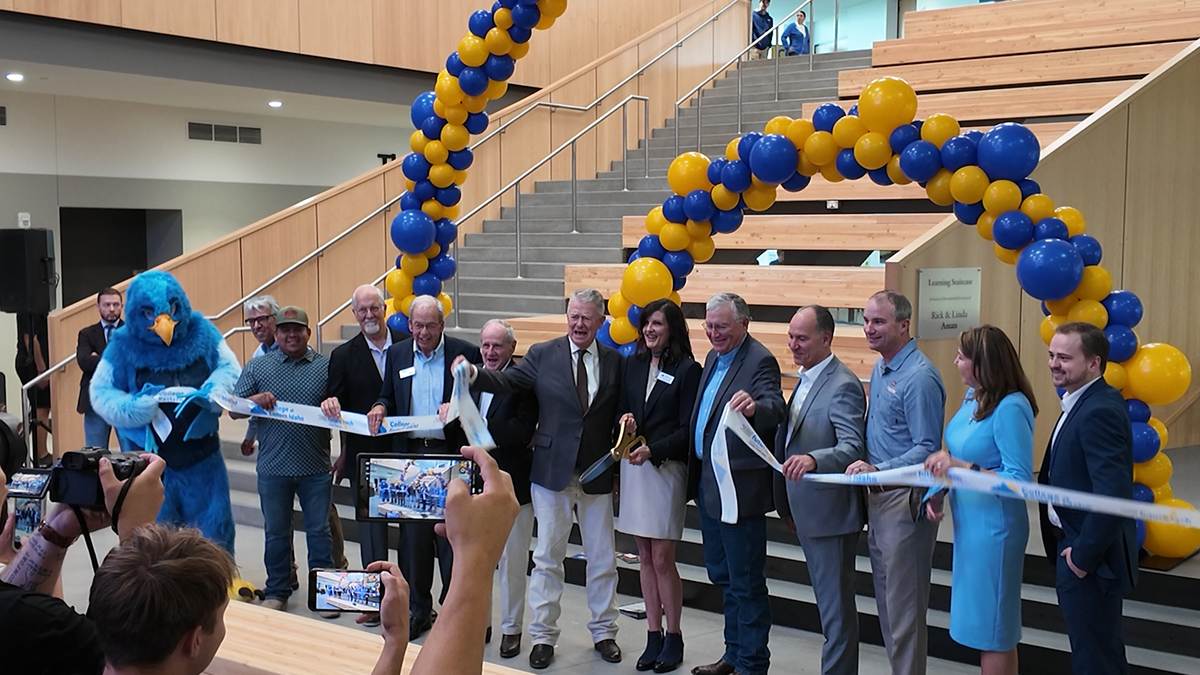

IDAHO FALLS, Idaho (KIFI) — The College of Eastern Idaho officially opened its new Future Tech Building Thursday, expanding space for technical programs as eastern Idaho prepares for growing workforce demand tied to nuclear energy, advanced manufacturing, cybersecurity and other high-tech industries.
The 88,000-square-foot Battelle Energy Alliance Future Tech Building in Partnership with Frontier Credit Union will house programs including cybersecurity, mechatronics and automation, energy systems, battery technology, advanced manufacturing, robotics, health physics, engineering and computer networking.
Gov. Brad Little, U.S. Sen. Jim Risch, Lt. Gov. Scott Bedke, Idaho National Laboratory Director John Wagner and other state, college and community leaders attended Thursday’s ribbon cutting.
Students will begin using the building when CEI’s fall semester starts Monday.
CEI President Lori Barber said the project has been about five to six years in the making and comes as the college continues to grow.
CEI says current enrollment is more than 1,900 students, up 7.7% from last fall.
Barber said the project was also driven by what employers across eastern Idaho have been asking CEI to provide.
“What they were telling us is we need high tech, high tech programs,” Barber said. “We need programs like our mechatronics, like cybersecurity, like engineering, engineering technology, electronic controls. All of those are workers who are needed with all of these amazing jobs that are coming to eastern Idaho.”
That demand is especially important as Idaho National Laboratory and companies connected to the nuclear industry continue to grow.
Barber said many of the jobs needed to support that growth are technician positions, not just engineering or research roles.
“We have so many companies, so many contractors that are coming here and they’re going to need those technicians,” Barber said.
She also pointed to demand outside the nuclear industry, including Micron and health care employers.
“This building in particular is driving economic development at its core,” Barber said. “We’re driving economic opportunity, we’re creating taxpayers for the state, we are creating prosperity for the state.”
INL says workforce demand is growing
Idaho National Laboratory Director John Wagner said the pace of work at INL has created an increasing need for people with technical skills.
“The pace and the need associated with what we’re working on at the laboratory right now is beyond anything it’s been in any modern history,” Wagner said. “And in order to keep that pace going, obviously we need people. We need people with those skill sets.”
Wagner said future INL employees do not necessarily need nuclear engineering degrees.
The laboratory needs workers across cybersecurity, mechatronics, engineering technology, health physics, skilled trades and other disciplines.
He also said INL staff have worked with CEI on curriculum development and instruction. Wagner pointed to mechatronics as one example of how those programs can connect directly to work underway at INL, including components for the MARVEL microreactor.
Employers looking for technicians
CEI mechatronics instructor Gary Holyoak said employers are already struggling to find workers with skills in electronics, pneumatics, hydraulics, robotics, automation and programming.
He said troubleshooting is one of the most important skills employers are looking for because equipment failures can quickly stop production or research.
Holyoak said the workforce is also going through what he called a “silver tsunami,” as baby boomers retire.
“We’re kind of at a critical juncture where we are transitioning from, I guess you could call it the silver tsunami, where the baby boomers are retiring, and there’s not enough Gen X to kind of fill a lot of those positions,” Holyoak said. “And so we need a lot of people to come in and fill those.”
Holyoak said technicians often play a different role than engineers, working directly with equipment to build, maintain and troubleshoot systems.
Workforce challenge could last decades
INL Manager for Workforce and Economic Development Hope Morrow said workforce development is one of the largest challenges facing the nuclear industry.
“I would say it’s probably one of the largest challenges that’s facing the nuclear industry,” Morrow said.
She said meeting future demand could require years or even decades of education and training.
“We’re talking about years and years and years, decades worth of workforce development and training and education that’s going to be critical,” Morrow said.
Morrow said INL, Battelle Energy Alliance and the U.S. Department of Energy cannot build that workforce alone.
“We need the education partners. We need the state partners. We need the elected officials to all lean in to help us do that,” Morrow said.
She said INL continues to need engineers and scientists, but also construction workers, fabricators, manufacturers and technicians as more projects move into demonstration and commercial development.
Morrow said CEI students can already follow several pathways into INL, including skilled trades, cybersecurity and engineering programs.
Risch points to Idaho’s nuclear role
U.S. Sen. Jim Risch tied CEI’s expansion to Idaho’s position in the nuclear industry.
“The biggest and most important factor that goes into anything we do is human resources,” Risch said. “And the institution here that is looking to the future and developing the programs that are wanted not only at INL, but a lot of places — this is the future.”
Risch said demand for nuclear energy is increasing nationally and internationally, particularly as electricity needs grow from artificial intelligence, data centers and other industries.
“When you think of the future of American energy, nuclear energy is what you think about,” Risch said. “And when you think about nuclear energy, you think about Idaho and you think about Idaho Falls.”
Battelle Energy Alliance and Frontier Credit Union are among the project’s major partners.
Frontier Credit Union CEO Dan Thurman said the company viewed the project as an investment in both students and the region’s future workforce.
“Education is one of the greatest investments that you can make,” Thurman said. “It creates opportunities, opens doors, and gives people the tools that they need to build meaningful careers and fulfilling lives.”
Thurman said Frontier’s involvement also includes support for scholarships at CEI, with a focus on students pursuing STEM-related programs.
During Thursday’s ceremony, Idaho National Laboratory Director John Wagner announced another $1 million installment toward Battelle Energy Alliance’s contribution to the project.
CEI President Lori Barber said 97 donors also helped support the new building.
Students will begin filling the classrooms Monday, with CEI positioning the facility as a direct link between education and the technical jobs already growing across eastern Idaho.