
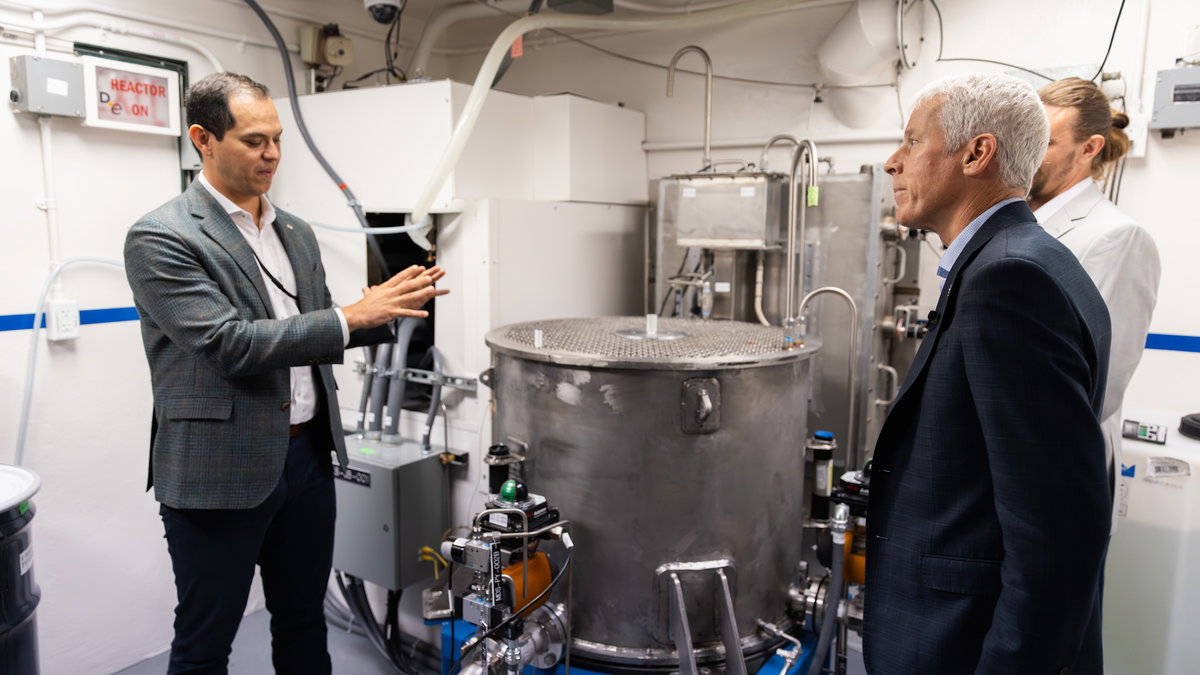

IDAHO FALLS, Idaho (KIFI) – Less than 48 hours after the third U.S. reactor achieved criticality this year, the founders of Deployable Energy offered an in-depth look at the technology driving America’s microreactor revolution.
The new Unity reactor core is small enough to fit inside the bed of an F-150 truck, yet generates enough electricity to power 700 homes for five years.
“The Unity Nuclear Battery is a one megawatt microreactor,” said Deployable Energy CEO Bobby Gallacher. “It’s a five percent Low-Enriched Uranium fueled reactor that’s light, water-moderated and helium-cooled.”
The advanced reactor’s design is transformational for its size and scalability.
“It fits within a 20-foot container that can be rapidly deployed on site,” Gallacher said. “That gives us near universal site ability to be able to meet the challenges required for energy in the future.”
Antares Nuclear’s Mark-0 reactor and Valar Atomics’ Ward 250 reactor were the first two advanced reactors to reach criticality in June through the Department of Energy’s Reactor Pilot Program.
“We created a system that has a self-sustaining, nuclear reaction,” said Deployable Energy Co-Founder and Chief Commercial Officer (CCO) Sanjay Mukhi. “This is what is needed for providing power to energy needs.”
The achievement allowed the company to “close out” President Donald Trump’s May 2025 executive order to successfully fire up three advanced reactors by America’s 250th anniversary.
“This is an exciting time for the nuclear industry,” Mukhi said. “Having three reactors go critical by the 4th of July – this order that President Trump set last year was a very bold move, and it really inspired the industry to move forward on pace, on time and deliver for the American people.”
While the executive order was issued fourteen months ago, Deployable Energyobtained its strategic partnership projects contract with the U.S. Department of Energy in January 2026.
“We started month nine and came in third,” said Gallagher, an Australian-born, technological entrepreneur. “Just imagine if we started month one.”
Deployable Energy manufactured the reactor core in April in Houston, placed it in the back of a pickup truck and drove it to Idaho National Laboratory.
“This is something that’s fantastic, and it’s never been done before – being able to miniaturize a nuclear reactor to that size and put it in the back of a car and drive it up to where it needed to go,” Mukhi explained. “Keep in mind, this was an unfueled system, and we were driving up just the reactor core, but this shows you how portable a system can be.”
The company is laser-focused on bringing down the cost of nuclear energy for consumers.
“In terms of costs, we’re talking about $0.15 to $0.20 a kilowatt hour for the first units to be delivered,” Gallagher said. “We believe by mid-2030, we’ll be under $0.05 a kilowatt hour. At those prices, that would be transformational to U.S. energy and the pathway to ensuring that we have not just the energy that we need now, but 10x more energy that we need in the future.”
Deployable Energy’s dozen engineers, researchers and scientists were supported by a team of 100 staff at Idaho National Laboratory in achieving criticality.
“INL has been a fantastic partner, along with the Department of Energy, to make a moment like this happen.”
The race to bring more advanced reactors online continues, with additional projects expected to achieve criticality in the near future.
“Now we look forward to the next step of bringing power to the grid with these advanced reactors,” Gallagher said.