
See the latest PCI Index
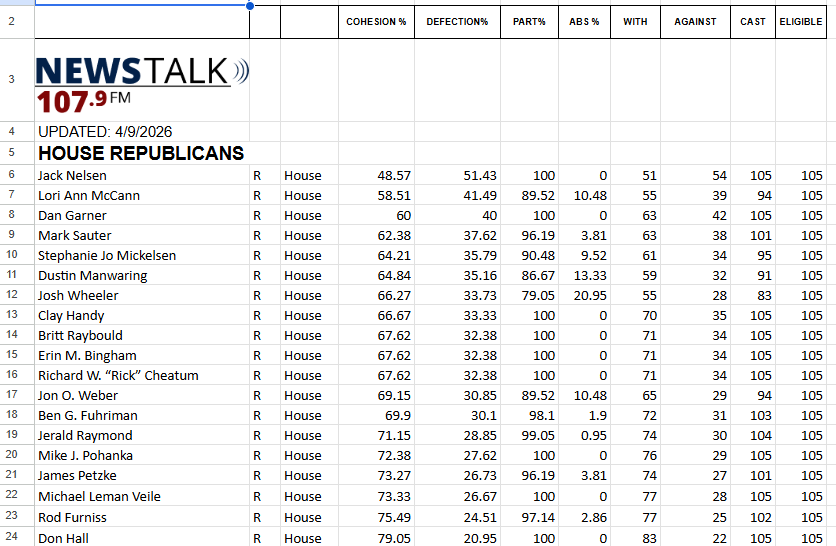
Newstalk 107.9’s legislative analysis provides a detailed look at how Idaho lawmakers align with their respective political parties, utilizing a metric known as a “Party Cohesion Score.” The report measures how frequently legislators vote with their party’s majority on the most politically divided issues of the 2026 session.
The scoring system is based on roll call votes in the Idaho House and Senate. Specifically, it focuses on votes where the Republican and Democratic caucuses split in opposite directions. These instances represent the most politically consequential moments of the session, when party lines are clearly drawn and lawmakers must choose between their caucus position and an alternative path. Out of all roll call votes only a fraction meet the criteria for a true party split, occurring when the majority of Republicans and the majority of Democrats voted on opposing sides.
The Party Cohesion Score represents the percentage of these votes where a legislator sided with their party’s majority. For instance, a legislator with a 95 percent score voted with their caucus on nearly all divided issues, while a lower score signifies more frequent departures from the party line. By excluding routine or unanimous votes, the report highlights the dynamics of legislative decision-making when tensions are highest.
To provide a more comprehensive view, the report includes several other data points. The Defection Rate tracks how often a lawmaker votes against their party’s majority on these key votes. Additionally, the Participation and Absentee Rates show how often a legislator was present and casting a vote. These metrics are designed to prevent misleading conclusions, such as high alignment scores resulting from strategic absences during controversial or difficult votes.
The analysis does not attempt to measure ideological purity or judge the content of specific bills. Instead, it serves as an objective description of voting behavior, focusing on moments when party divisions are most pronounced. The data set includes both House and Senate members and is updated periodically as new votes occur. This allows the cohesion scores to shift as more party-split votes are recorded throughout the remainder of the session.